Collector Value Est.
$3,900–$7,000
USD · Market estimate
Near-mint / restored. Worn or stored examples sell for 30–60% less.
Bally · 1993
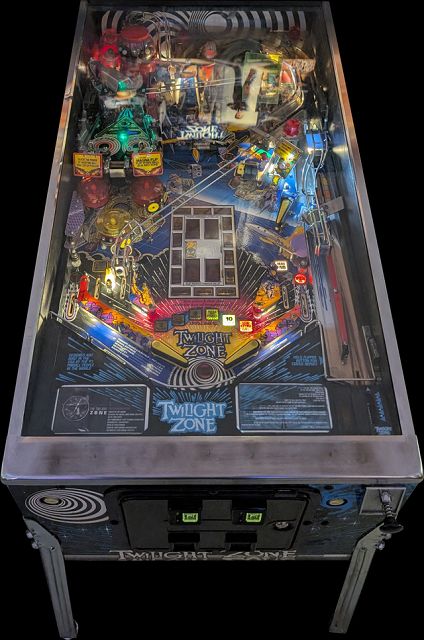
Twilight Zone
“Twilight Zone includes more features with patents pending than any other game in history!" "Enter Into a New Age of Pinball" "The Profit Zone. (with PlayMeter and Replay ratings)" "You have just crossed over... into the Twilight Zone”
Notable Features
Flippers (4), Pop bumpers (3), Ramps (2), Dual left inlanes, "Rocket" kicker. Dual autoplunger/manual plunger arrangement. Maximum 1 buy-in ball per player (operator option). Magnets on the main playfield are situated on the looping lane and catch the ball to aid in hitting shots into the camera and piano. They are not under player control. Magnets on the mini-playfield 'flip' the ball during "Battle the Power" mode when the player presses the flipper buttons. The "Powerball" is a ceramic pinball about 20% lighter than a steel pinball, much faster, and not affected by the game's magnets. Five possible multiball modes: "Powerball Mania", 3-ball; "Fast Lock", 3-ball; "Lost in the Zone", 6-ball wizard mode; "Regular Multiball", 3-ball sequential release, without 3rd magnet installed; "Regular Multiball", 3-ball simultaneous release, with 3rd magnet installed.
Historical Notes
This game was part of Williams/Midway's "SuperPin" line of widebody games. Voice-over artist Tim Kitzrow provided the voice of Rod Serling. Rod Serling's likeness had to be licensed separately from the "Twilight Zone" name. Retrofit instructions for third playfield magnet (removed in production games) available here. An article by Ted Estes about designing Twilight Zone is available at GameRoom Magazine. Another article shows differences between prototype and production games. Here is an Italian language translation. Twilight Zone was originally to be the first game to use Williams' then-new DCS Sound System (which would actually be introduced for Williams' 1993 'Indiana Jones: The Pinball Adventure'), but due to time constraints concerning the production of the DCS board, the music was recomposed for the Yamaha YM2151/Harris CVSD audio board. It is also therefore the last game to use that audio board. We asked Chris Granner to tell us about the music for this game. He replies:The main play tune for TZ is a WPC (synthesized) version of the loooonnnng guitar solo section from Golden Earring's "Twilight Zone". The Jackpot tune is a WPC version of the CHORUS of that song, where you hear the main melody of the song. There are snippets and takeoffs from dozens of TV show moments, way too many to list. The actual AUDIO from either of these sources is NOT reproduced in TZ pinball. In this listing is an image of a playfield under blacklighting, revealing a serial number. We asked Pat Lawlor why the manufacturer did this. He replies:The reason for the serial numbers seems strange by today's standards. In 1992, Williams' agreement with its distributors gave them exclusive sales right to a territory. They did not have the right to sell outside of their territory. But some were doing just that. In order to track the game's origin from a distributor into the wild, the blacklight number was added. Williams knew where the game was originally shipped. If the game turned up outside of that territory, it was assumed that the distributor had "Bootlegged" the game outside of his territory. Then it was up to management to decide what penalty to incur on the offender. Remember, this was during a time when it was PROFITABLE to sell and operate pinball machines. This practice would be laughable today because ANY sale of a pinball machine is a good sale.
Where to Play It
Find Twilight Zone on location.
Current addresses, hours, and condition reports from the Pinball Map community.
Data from pinballmap.com, a community-maintained directory of public pinball locations.
Looking to own this machine?
Get alerted the moment a Twilight Zone surfaces in our network.