Collector Value Est.
$2,600–$4,600
USD · Market estimate
Near-mint / restored. Worn or stored examples sell for 30–60% less.
Williams · 1990
Rollergames
“Stay on Track with another Williams Winner!" "Let the Good Times Roll!”
Notable Features
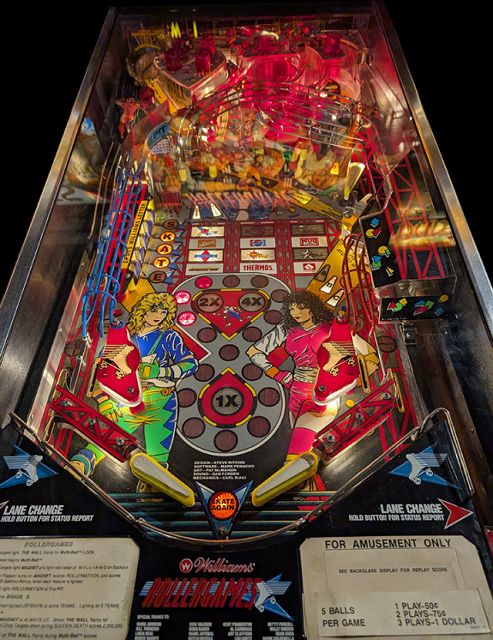
Flippers (3), Multiball, ball-catching magnet near upper flipper, two-stage kickback in left outlane (shoots the ball straight up a little ramp, onto another kicker that is not otherwise in play, and finally around the orbit to the upper right flipper).
Historical Notes
Pat McMahon was the artist for both backglass and playfield. Linda Deal did the backbox art. Mark Penacho informs us that Steve Ritchie was the male voice but does not remember who the female voice was. The music vocals were not from the TV show; they were recorded locally. The singer was a friend of Dan Forden but Mark did not know her name. The magnet on this game is at the end of the upper (right) flipper. There's a "magnet' shot just to the left of center that leaves the ball in a saucer. When hit (when lit), the game says, "Don't Flip!", a VUK fires the ball up, through a wireform, and right in front of the flipper, where it sticks on the magnet. The game says, "Flip!", and the ball goes right up the ramp. The "wall" ramp shot, when "ball lock" is lit, leads the ball down a wireform ramp to a capture area. When 2 balls have been captured and the ball lock is lit, the two balls in the lock area will eject, travel around a circular wireform ramp over the playfield and return to the capture area. Making the third ball lock begins multi-ball. This game has very addictive background music, with separate tunes for the standard game, 2 ball lock, multi-ball, "go for the wall", and jackpot mode. The prototype game shown here, serial number 576X360003, has five drop targets instead of five standup targets. Reportedly, a few production games were made with these drop targets before they were changed to standup targets for the remainder of the production run. In our Files Section is the original ROMs for these drop targets (AD2, for American Drops) from Williams. This prototype game also has the expected red lamp boards under the playfield. Also shown here are pictures of an Early Production backbox, serial number 576I365026, showing a different speaker panel and providing for fifteen flasher bulbs. Very early machines had fifteen #906 flashers in the backbox inserts. They were removed after the samples were made, but Williams used up the harnesses and inserts that they had left. Because of this, there were games with flashers, games with holes for flashers but no sockets and harnesses, and games that didn't have the holes. Production Run Records for Rollergames: Production Start Date: Apr-4-1990 Production End Date: Jun-21-1990 Production Run Quantity: approximately 5000, adjusted from 5100 without notation. First ship date: Apr-5-1990 Last ship date: Oct-17-1990 Rollergames was a short-lived roller derby TV show.
Where to Play It
Find Rollergames on location.
Current addresses, hours, and condition reports from the Pinball Map community.
Data from pinballmap.com, a community-maintained directory of public pinball locations.
Looking to own this machine?
Get alerted the moment a Rollergames surfaces in our network.